
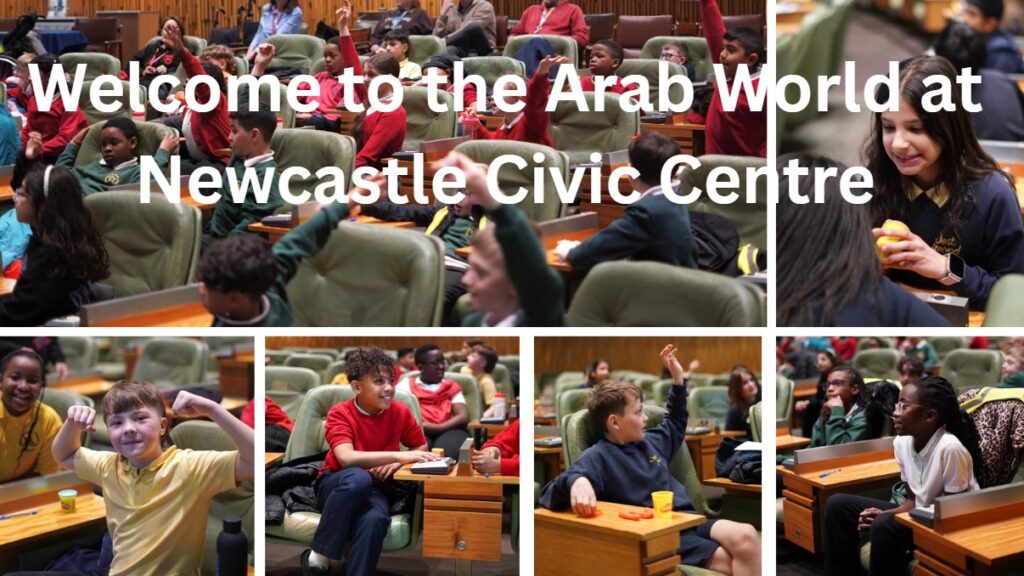
Article written by Rebeca Villarroel Altamirano, with photos from Rebeca and Amar Sasidharan Pillai (Festival interns – Digital Content Creators)
Over 200 pupils from Years 5 to 8 and their teachers from Gosforth Central Middle School, Blaydon West Primary School, West Jesmond Primary School, St Paul’s CE Primary School and Kingston Park Primary School took part in two half-day Welcome to the Arab World sessions at Newcastle Civic Centre on 23rd March.
One of the highlights of the Festival, the events introduced children to the language, cultures and traditions of the Arabic-speaking world through a range of interactive activities designed to spark curiosity about languages and global cultures. Pupils took part in three sessions, starting with an exploration of the Arab World with Jonathan Featherstone, followed by two workshop activities involving learning to speak to each other in Arabic and Arabic letters with Saleh Patel and an Arabic Calligraphy session with Abu Yahya. Each element focused on a different aspect of the Arabic-speaking world, allowing pupils to experience language learning through both knowledge-based and hands-on activities.
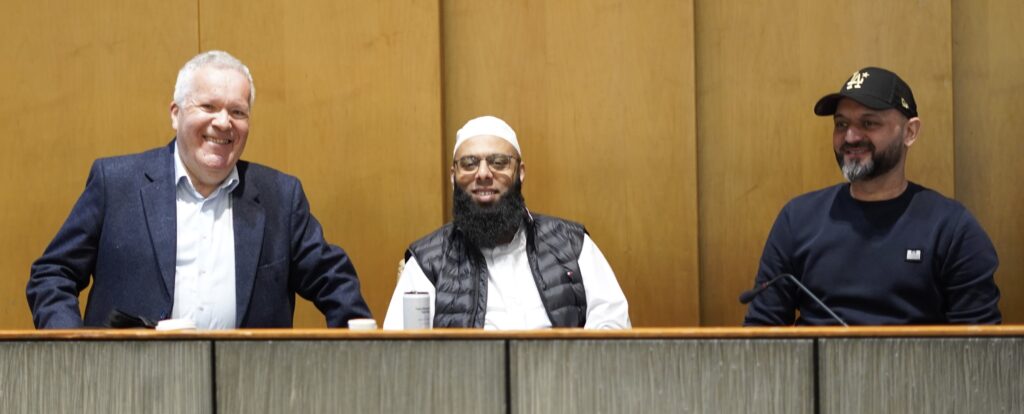
The event was funded by QFI for the fourth successive year as part of the Festival – with three experts from around the country coming to Newcastle to share their passion and knowledge of the Arab World and Arabic with children in the North East.
Pictured – Welcome to the Arab World Day presenters (left to right): Jonathan Featherstone, Saleh Patel and Abu Yahya
It was a memorable day for everyone. Our Arab World experts were impressed by how enthusiastically the children participated in all of the activities and the children clearly had fun and learned a lot.
An introduction to the Arab World with Jonathan Featherstone
The events began with an Introduction to the Arab World led by Jonathan Featherstone, Arabic teacher at the University of Cambridge and Honorary Fellow in Islamic and Middle Eastern Studies at the University of Edinburgh. In this session, pupils went on a journey across the Arab World and explored the geography, people and cultural traditions found across Arabic-speaking countries.
Children engaged with Jonathan’s presentation answering questions on a wide range of topics from football to food, religions to architecture and many amazing facts about the 22 countries that make up the Arab World and 500 million native speakers of Arabic. They took part in a fun quiz to test how much they had learned and ended the session clapping along to a rap song in Arabic. The interactive activities engaged the pupils throughout and the quiz helped reinforce key ideas from the presentation in a fun and memorable way with pupils knowing a lot more about the Arab World than they had before.

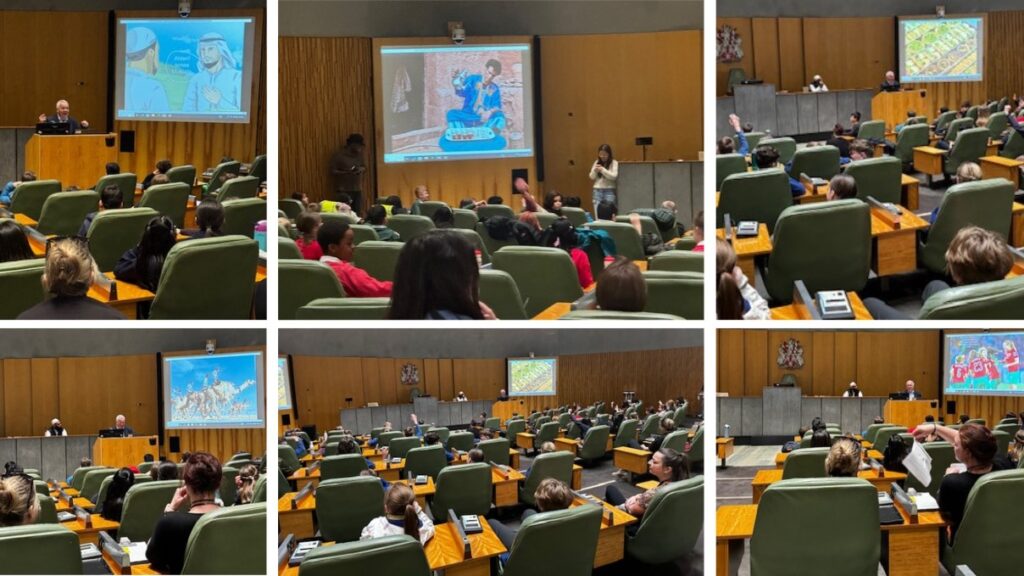
Arabic is the second most spoken language in Newcastle — a language that opens the door to a whole culture. I think that Arabic is something which can really inspire and engage children a lot particularly when it is made into fun. The children were so enthusiastic to share their own knowledge and also to find out new things about the Arab World that will hopefully open their minds and broaden their perspectives.
Jonathan Featherstone, Honorary Fellow in the Department of Islamic and Middle Eastern Studies at the University of Edinburgh
Arabic language and culture workshop with Saleh Patel
Pupils engaged enthusiastically in this workshop led by Saleh Patel, an Arabic teacher from Horton Park Academy in Bradford and an expert who has travelled the world sharing his practice on teaching Arabic. During the workshop, children were introduced to common greetings and simple expressions while developing confidence in speaking Arabic aloud. They repeated words together, listened carefully to pronunciation and experimented with unfamiliar sounds and a different writing system.
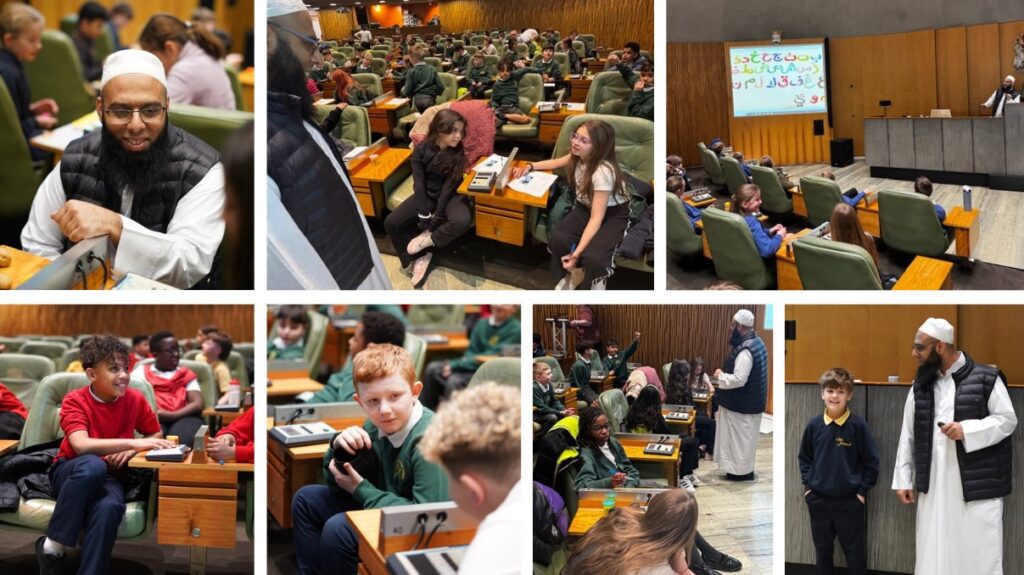
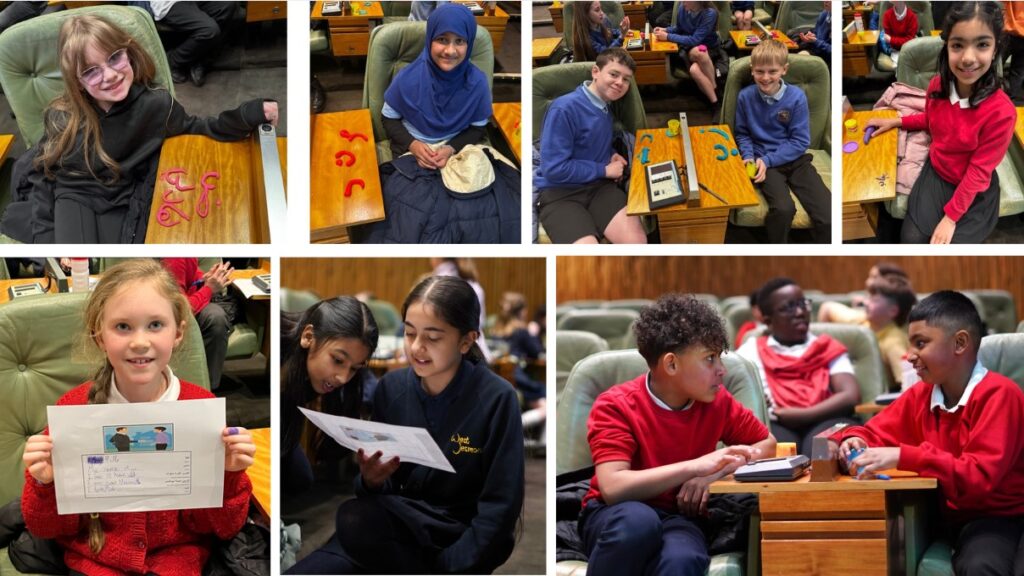
As part of the workshop, the children also practised basic phrases used when introducing themselves, including: “Ahlan أهلاً” (Hello), “Ismi اسمي” (My name is…) “Umree ashra sanawat عمري عشر سنوات” (I am 10 years old) and “Ana min madina أنا من المدينة” (I am from …). Using these expressions gave them an opportunity to try speaking Arabic for the first time and showed how learning a new language can be both approachable and enjoyable.
For many pupils, the highlight of the workshop was creating letters from the Arabic alphabet using Play-Doh. This hands-on activity allowed them to explore the shapes and curves of the Arabic letters in a creative way while also helping them understand how the writing system differs from the Roman alphabet used in English. By physically shaping the letters, pupils were able to engage with the language in a playful and memorable way. They all got to take their playdoh and worksheets with them.
It was lovely to see how engaged the children were while learning a new language. In general, I think it is very important for children to learn other languages, as it allows them to discover different cultures and become global citizens.
I would like to extend my sincere thanks to the organising team for hosting such a wonderful Arab Pupil Day in Newcastle. It was a pleasure to be part of the event as a presenter, and I truly appreciated the opportunity to contribute. The day was incredibly well organised, and it was inspiring to see such a positive and engaging environment created for the pupils. Events like this make a meaningful difference, and I am grateful to have been involved.
Saleh Patel, Arabic teacher from Horton Park Academy in Bradford
Arabic Calligraphy workshop with Abu Yahya
Pupils enjoyed learning about Arabic calligraphy with renowned calligraphy artist Abu Yahya. During the workshop, they practiced writing Arabic using special brush pens and templates that helped them recognise the shapes and patterns of the letters. The activity also introduced pupils to the artistic side of Arabic writing, showing how calligraphy has long been an important form of cultural expression across the Arabic-speaking world.
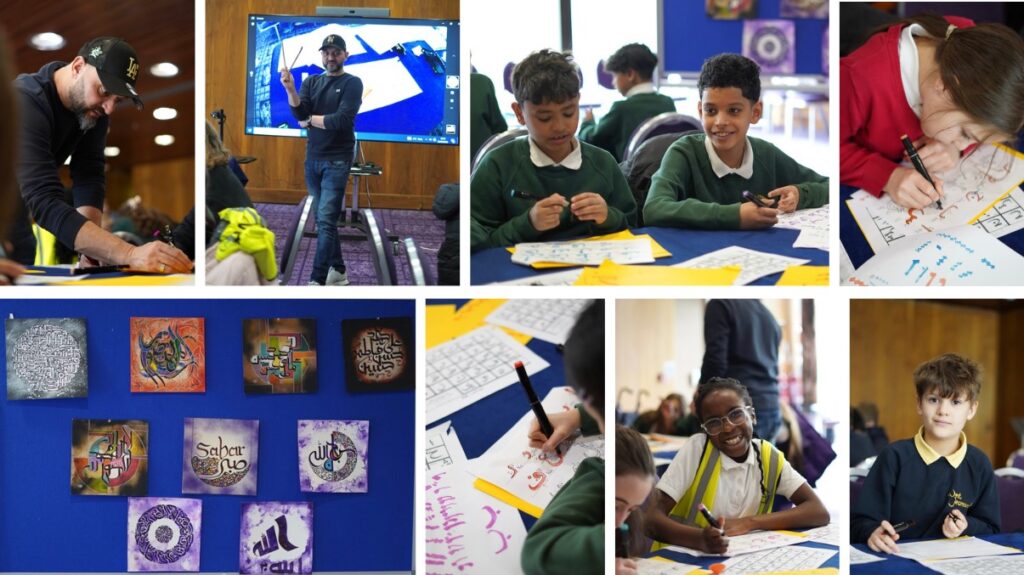

At the end of the session, Abu Yahya wrote pupils’ name in Arabic script on a sheet of paper, which was given to the teachers to display in their classrooms. Pupils were able to take their own calligraphy as a special keepsake and a reminder of the their first experience learning about Arabic calligraphy.
This is my fourth year running these kinds of workshops here, and it gets better every year. Arabic calligraphy is important because it’s not just writing—it’s art, history, and culture all in one! Introducing Arabic to school children is very important as it provides them new opportunities to think about for their future.
It’s wonderful to see the children so keen to learn a new language. I think it’s crucial for them because when they travel to one of these countries – or even if they manage to get a job there – they will be able to benefit much more, especially as the Middle East is currently a growing market.
Abu Yahya, Calligraphy Artist (Abu Yahyaz Art)
Feedback from staff and pupils
Overall, the event offered pupils a rich and engaging introduction to the Arabic language and culture. By combining interactive activities with cultural insight, the event encouraged curiosity and enthusiasm for languages and the world in their classrooms and beyond.
We got involved in this event because we believe it is a great opportunity for children to learn about a new culture that some of them may not encounter in their daily lives. It’s also really good to celebrate and promote the diversity we have in our school area.
Josh Walton, Class teacher at West Walker Primary School
We recently started an Arabic club at our school, so our pupils are already quite familiar with the Arabic language and culture. That’s why we were sure they’d love coming here. We encourage everyone to get involved in the NE Festival of Languages.
Sarah Kasher, Learning Support Assistant at Kingston Park Primary School
I really enjoyed today’s event because I was able to speak in Arabic. If I had to sum up today’s event in a single word, it would be ‘inspirational’.
Lucy, Pupil at Gosforth Central Middle School
For me, the highlight of today was the Arabic calligraphy session because I love drawing, so it was fun to explore different types of strokes.
Ariana, Pupil at Kingston Park Primary School
It was great learning Arabic today through lots of different activities.
Libby, Pupil at West Walker Primary School
Further information and links
Welcome to the Arab World Day was organised by Sarah Edgar (Newcastle City Council, School Effectiveness) and Declan Baharini (International Newcastle and Festival Coordinator) in association with support and funding from Qatar Foundation International.
- Learn more about who QFI is and how they can support you at www.qfi.org, and contact: communications@qfi.org.
- Click here to explore other Festival events and activities featuring Arabic, plus resources and support available from Qatar Foundation International and the North East Arabic Teaching Council.
- QFI supports the North East Arabic Teacher Council by cultivating a collaborative network for Arabic educators through professional development, workshops, and resource sharing. Based in Washington, D.C., QFI enables this ecosystem to expand access to quality instruction and amplify collective impact, directly fulfilling its mission: Advancing the value of teaching and learning Arabic as a global language.
- If you are an Arabic language school teacher based in the North East, have an interest in starting your career in Arabic teaching, or would like to introduce Arabic teaching into your school curriculum, please get in touch with Hassina Chachou or Caroline Afolabi-Deleu by emailing: languages@s4a.org.uk

About the author and photographers
Rebeca and Amar are part of the team of five Festival interns from Northumbria and Newcastle Universities producing articles and digital content for the Festival this year. The Festival wants to provide opportunities for students to gain real-world experience to help them in their future careers.
Rebeca Villarroel Altamirano is from Peru and is is a Media, Communications and Cultural Studies student at Newcastle University. She is passionate about advertising, marketing and PR and is developing her skills in content creation, social media and audience engagement.
Amarnath Sasidharan Pillai is doing an MSc in Business Analytics with Advanced Practice at Northumbria University. He is passionate about creating digital content and has experience in social media management, content creation, photography, videography, and video editing, with extensive hands-on work covering multiple festivals and live events in Newcastle and Sunderland. You can see Amarnath’s portfolio online here