
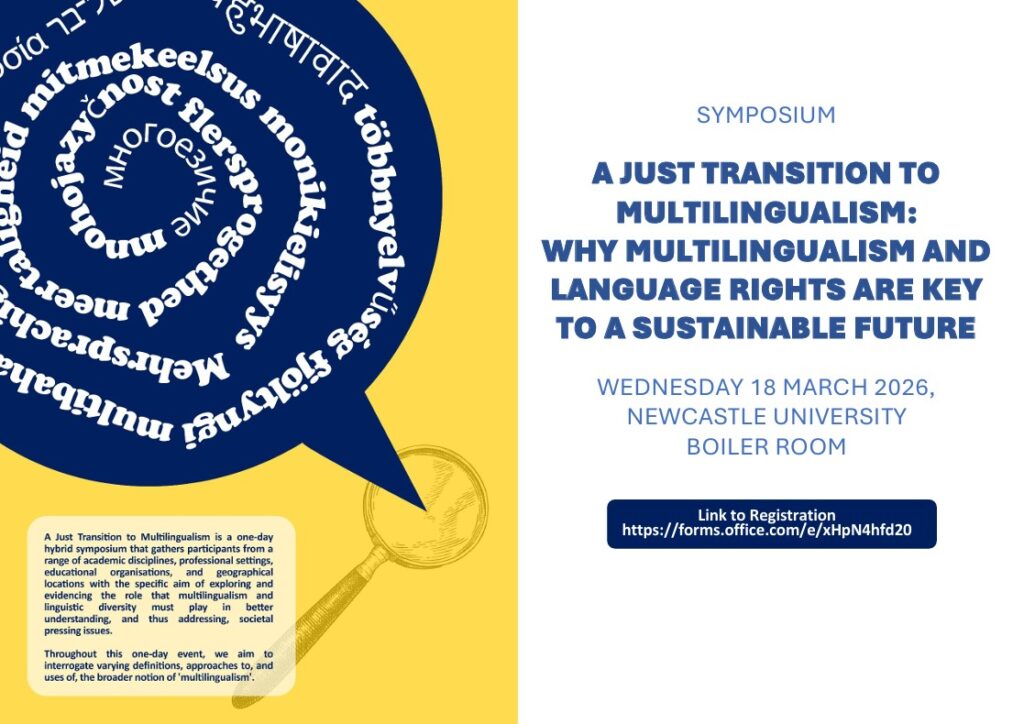
Newcastle University is holding a special event, informed by a survey for schools, to explore multilingualism and the roles that this and linguistic diversity play in better understanding and addressing societal issues, from education and social justice, to digital technologies and a sustainable and thriving future.
With academics from Newcastle and Edinburgh, SOAS University of London, UNESCO and Linguapax, the invitation for the event is for educators and a wide range of professionals and academic disciplines and geographies. There will also be a performance by the multilingual choir.
Schools survey on multilingualism (responses by 13th March)
Newcastle University school of Modern Languages have prepared a short survey for teachers in relation to the Multilingualism event (8 questions). Responses would be welcomed from teachers across the region to inform discussions – from all subject areas, but it may be of particular interest to language teachers and those involved with English as an Additional Language and Schools of Sanctuary. Senior school leaders are also requested to respond with their views.
Schools are also requested to be involved in the development of a 10-point manifesto which will be produced after the event on 18th March.
The questions schools are asked to respond to are:
- Does your school complement the teaching of a single MFL language with a programme that encourages broader multilingual awareness of Home, Heritage and Community Languages (HHCL)?
- Are Home, Heritage and Community Languages (HHCL) a decisive factor for how pupils define their personal identities?
- Can you remember an occasion when the multilingual nature of your classroom helped you to learn new linguistic or cultural knowledge, and your student(s) became “teachers” for the rest of the class?
- What knowledges stored in particular HHCL languages in your classroom have you been able to use in your language teaching practice?
- Have you used AI in your language teaching? If YES name how you have used AI in the classroom or in your activity design?
- What do you think are the possibilities and limitations when using AI (for instance, for translation)? Do you discuss critical uses of technology (e.g. hallucinations, what languages are well supported, ethical issues regarding data, and environmental costs of these technologies) with your students?
- Does your school have a partner school abroad and/or is it involved in international projects? Please provide details if possible.
- Do you collaborate with a university in the region for activities that promote language learning in schools? What kinds of activities are most relevant to you and your students?